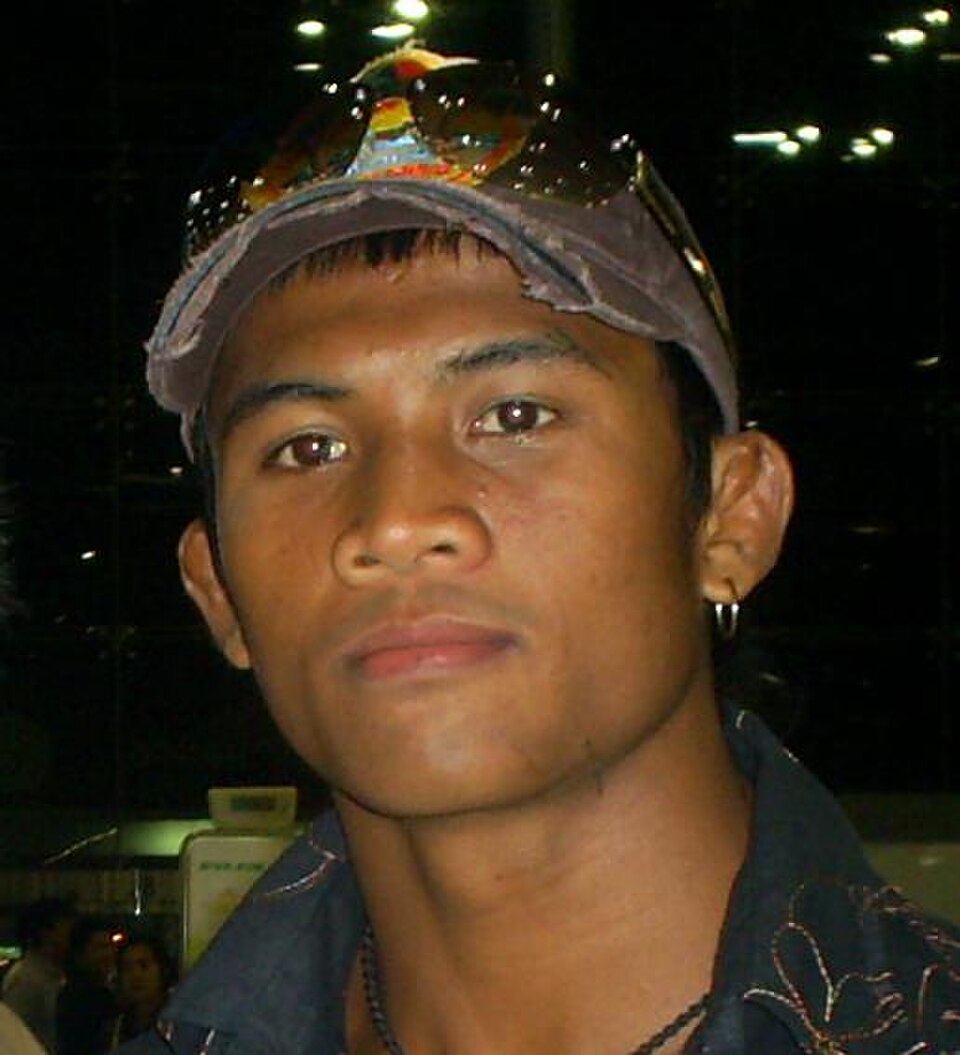
Buakaw Banchamek
Legend of Muay Thai · Active 1999—present

BUAKAW BANCHAMEK

"The White Lotus"

The fighter who carried muay thai onto the global stage. Best known for his ferocious left kick, granite chin, and back-to-back K-1 World MAX titles in 2004 and 2006 — the moment muay thai stopped being Thailand's secret.

K-1 World MAX Champion (2004)K-1 World MAX Champion (2006)Shoot Boxing S-Cup World Champion (2010)Thai Fight 70kg Tournament Champion (2011)Thai Fight 70kg Tournament Champion (2012)Toyota Marathon 140lb Champion (Lumpinee) (2002)Omnoi Stadium Featherweight Champion (2001)Omnoi Stadium Lightweight Champion (2003)Thailand Featherweight Champion (PAT) (2001)WMC Junior Middleweight World Champion (2011 & 2014-15)WBC Muaythai Diamond World Champion (2014)Wu Lin Feng 70kg World Champion (2015)Rajadamnern Stadium Hall of Fame (2026)
Born
8 May 1982
Hometown
Surin, Thailand
Height
174 cm
Weight
70 kg
Stance
Orthodox
Style
Muay Mat (pressure fighter)

Fight record

284
Total professional fights
245
Wins
25
Losses
14
Draws

Buakaw turned professional at the age of eight years old, fighting in countryside festivals around Surin for prize money to send back home. By the time he reached Bangkok at fifteen, he had already accumulated more than 60 professional fights.

Of his 220 wins, an estimated 112 came by knockout — an extraordinary rate for muay thai, where decisions dominate. His signature finish was the left middle kick, often delivered after wearing opponents down through methodical clinch work.

The story

Sombat Banchamek was born in 1982 to a farming family in Surin, the rural northeast of Thailand known as Isaan — the region that has produced a disproportionate share of the country's fighters. He started fighting at eight, the age many Isaan boys first step into a ring, and the prize money he earned went home to help support his siblings. He fought under an early ring name, Damtamin Kiat-anan, long before the world would know him as Buakaw.

The turning point came in 1997, when at fifteen he moved to the Por Pramuk gym near Bangkok. It was there that the raw country fighter was sharpened into a stadium-level professional. The belts followed: an Omnoi Stadium featherweight title, the Thailand featherweight championship, then a second Omnoi belt at lightweight. In December 2002 he won the Toyota Marathon tournament at Lumpinee — the temple of the sport — beating Japan's Satoshi Kobayashi in the final. He was no longer a prospect. He was a champion.

"He kicks like he's swinging a baseball bat. There's nothing technical about it — it's just power, and he's going to break you."— Mike Zambidis, on facing Buakaw

But the fights that made him a global name happened outside Thailand. In 2004, K-1 — Japan's glittering kickboxing promotion — ran its World MAX tournament, and a relatively unknown Thai walked through John Wayne Parr, Takayuki Kohiruimaki and the reigning champion Masato in a single night to take the title. For most of the watching world, it was the first time they had really seen muay thai: not as folklore, but as a man methodically dismantling the best strikers on the planet. He won it again in 2006, defeating Andy Souwer by TKO in the final, becoming the first fighter to win K-1 World MAX twice.

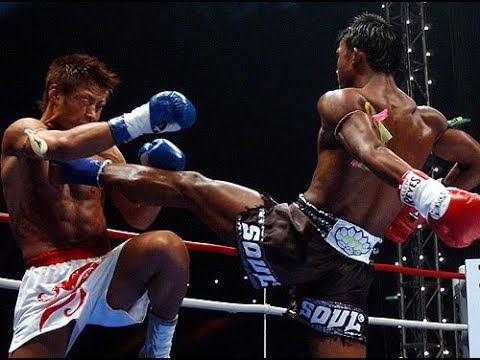
What made Buakaw exceptional was never subtlety. Where a fighter like Saenchai dazzles with footwork and feints, Buakaw walks you down. His style is muay mat — the heavy-handed, forward-pressure boxing of Thailand's eastern provinces. The signature weapon is the left switch kick, thrown with full hip rotation and built to break ribs and femurs. But the cliché of Buakaw as a pure brawler misses what coaches actually point to: an unusually high ring IQ, a long guard he uses to walk through fire, and an ability to read an opponent's weight distribution and punish whichever leg is stuck. The power is what people remember. The timing is what won the fights.

The 2012 split from Por Pramuk was the ugliest chapter. After years of what he described as poor treatment and disputes over his earnings, Buakaw simply stopped showing up to the gym. The fallout was public and ended in court. He emerged with his own camp — Banchamek Gym — and his own name, the one he carries today. He has kept fighting well into his forties, mixing legitimate bouts with exhibition spectacles, bare-knuckle one-offs, and a parallel life as an ambassador for the sport, an actor, a businessman, and in 2023 the holder of a Guinness World Record for leading the largest-ever wai kru ceremony.

He is, by most reasonable measures, the fighter who did more than anyone to carry muay thai out of Thailand and onto the world's screens — not because he was the most technical Thai of his generation, but because he was the most watchable.
Career timeline

1990
Started fighting at age 8, in Surin province
1997
Moved to Por Pramuk gym, near Bangkok, age 15
2001
First major belt — Omnoi Stadium featherweight
2002
Won Toyota Marathon tournament at Lumpinee Stadium
2004
K-1 World MAX champion — beat Masato in the final
2006
K-1 World MAX champion again — first to win twice
2010
Shoot Boxing S-Cup World champion
2012
Acrimonious split from Por Pramuk; founded Banchamek Gym
2023
Guinness World Record — largest wai kru ceremony
2024+
Still fighting selected bouts into his forties

Defining fights

vs Masato
WIN · Decision
K-1 World MAX 2004 Final · 2004
The fight that announced muay thai to the world. Buakaw beat Japan's biggest star to take his first K-1 title.
vs Andy Souwer
WIN · TKO R2
K-1 World MAX 2006 Final · 2006
Revenge for his controversial 2005 final loss to Souwer. A flurry of punches and three knockdowns sealed his second title.
vs Masato
LOSS · Decision
K-1 World MAX 2007 Quarter-final · 2007
Despite landing heavy leg kicks all fight, a first-round knockdown and Masato's punch volume swung the judges.
vs Saenchai
— · Bare-knuckle, decision
BKFC Thailand 5 · 2023
Two of Thailand's greatest, finally sharing a ring — under bare-knuckle rules. Buakaw took the decision.

Watch Buakaw fight

Key moments

0:23
Buakaw's entrance — wai khru ram muay
1:08
Round 1 — feeling out, low kicks land
1:45
The fatal left middle kick
2:12
Masato down, ten count begins
2:30
Crowd reaction, Buakaw wai's to corners
3:18
Trophy ceremony, Por Pramuk celebrate

Fighting style

The left switch kick

His signature weapon, thrown with full hip rotation. Buakaw is genuinely ambidextrous — his lead switch kick lands as hard as most fighters' rear kick, which makes charging at him reckless. He varies the angle: a straight leg lands to the side of the body, a bent leg drives the shin square into the opponent's forward momentum.

The long guard

An underrated part of his game. Buakaw extends his lead arm into a classic muay thai long guard, framing the opponent's collarbone and controlling their posture while walking through punches and head kicks. When opponents punch around it, he switches to a tight high guard mid-exchange.

Reading weight distribution

What separates him from a pure brawler. Buakaw times low kicks for the instant an opponent's weight is committed to one leg, making the kick almost impossible to check. Against a heavy lead leg, he attacks it as the opponent punches; against an active lead leg, he targets the back leg instead.

Walk-down pressure (Muay Mat)

The aggressive forward-pressure style of Thailand's eastern provinces. Where a Muay Femur fighter like Saenchai dances, Buakaw stalks — closing distance methodically and compounding damage until opponents break.

Where he trained

Frequently Asked Questions

Is Buakaw still fighting?

Yes — into his forties, mostly in selected exhibition and special-rules bouts. He took fights as recently as 2024 and remains active, while also running his own camp and serving in various roles in Thai kickboxing administration.

Why did Buakaw leave Por Pramuk gym?

A 2012 dispute over what he described as poor treatment and unfair handling of his fight earnings. He stopped attending the camp, the fallout went public and ended in court, and a settlement eventually let him fight freely again. He went on to found his own camp, Banchamek Gym.

Who is better — Buakaw or Saenchai?

The eternal debate. Buakaw represents power and forward pressure; Saenchai represents technical mastery and footwork. They've shared a ring under bare-knuckle rules, but a definitive prime-versus-prime muay thai answer doesn't exist. Most fans treat them as 1A and 1B of their generation rather than ranking one clearly above the other.

Can you train with Buakaw at Banchamek Gym?

Yes. Banchamek Gym accepts foreign students, and Buakaw teaches selected sessions — typically for more advanced students. He has also developed Buakaw Village in Chiang Mai province, a training-and-accommodation complex built to handle the demand from visitors.

What does 'Buakaw' mean?

Buakaw (บัวขาว) means 'white lotus' in Thai. The lotus — rising clean from muddy water — is a recurring image in Thai Buddhism. The name was given to him by his first camp.

What made Buakaw so influential?

Timing and visibility. His back-to-back K-1 World MAX titles in 2004 and 2006 came at the exact moment international audiences were discovering the sport, and his aggressive, knockout-oriented style translated perfectly to a global audience that had never watched stadium muay thai. He became, in effect, the sport's first worldwide ambassador.

Follow Buakaw Banchamek

Other legends